


Blogs
Every year, Incoterms machinery buyers lose thousands of dollars not because they sourced the wrong equipment, but because they misread their shipping terms. A single line on a quote sheet that says “EXW factory price China machinery” can look like a bargain while hiding high hidden costs that only appear once the shipment is in motion.
For Incoterms machinery buyers, understanding trade terms before placing an order is not optional; it is the difference between a profitable import and an expensive lesson. This guide breaks down EXW, FOB, CIF, and other key terms in plain language so you can make the right call on every shipment.
What Are Incoterms in Machinery Import?
Incoterms (International Commercial Terms) are globally recognized trade rules published by the International Chamber of Commerce. They define who pays for shipping, who carries insurance, who handles customs clearance, and the exact point at which risk passes from seller to buyer in any cross-border transaction.
For Incoterms machinery buyers, understanding trade terms is just one part of the broader process of buying machinery from China successfully.
Why Incoterms Matter in Machinery Trade
- Cost responsibility: Incoterms define precisely which party covers freight, insurance, export documentation, port handling, and import clearance.
- Risk transfer: They establish the exact point where the seller’s liability ends, and the buyer’s begins, critical when shipping heavy, high-value machinery.
- Dispute prevention: Written incoterms in a purchase contract remove ambiguity and protect both parties if goods are damaged or delayed in transit.
Overview of Common Incoterms for Machinery Buyers
Incoterms machinery buyers encounter most frequently fall into five categories. Each shift costs and has a different responsibility:
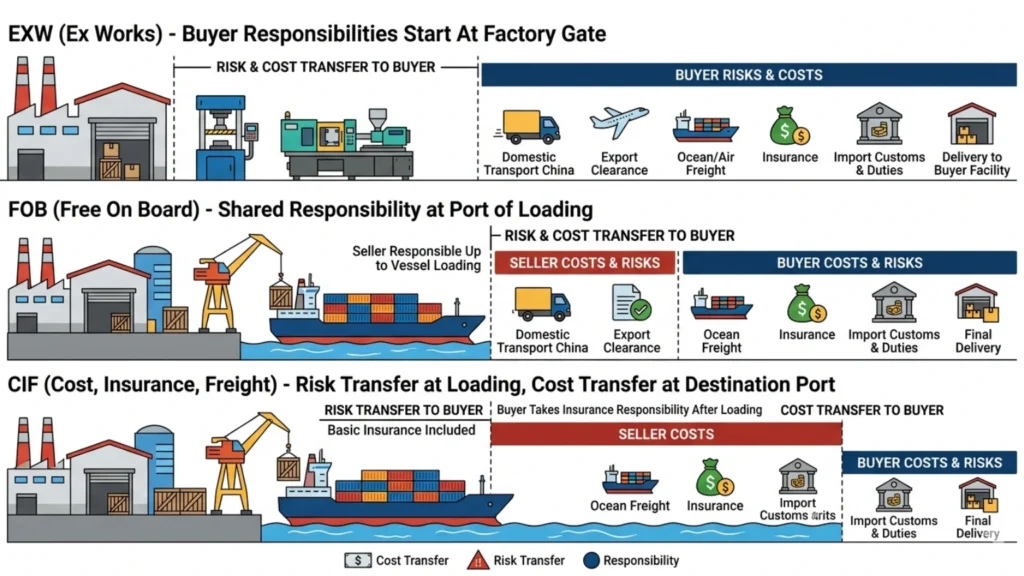
EXW (Ex Works): The seller makes goods available at their factory. The buyer handles everything from that point, including inland transport, export clearance, and ocean freight. The EXW factory price China machinery quote is the starting point, not the finish line.
FOB (Free On Board): The seller delivers goods to the named port and loads them onto the vessel. FOB China machinery shipping terms are the most widely used in machinery trade because they split logistics responsibility at a natural boundary.
CIF (Cost, Insurance, Freight): The seller arranges and pays for shipping and basic insurance to the destination port. CIF shipping meaning machinery import does not include import duties or destination charges.
DAP (Delivered at Place): The seller delivers to a named destination in the buyer’s country, excluding import duties.
DDP (Delivered Duty Paid): The seller covers all costs including import duties. The buyer simply receives the goods.
EXW Explained for Machinery Buyers
When suppliers in China quote an EXW factory price China machinery rate is almost always the lowest on paper. It is a factory-level price stripped of all logistics costs. For incoterms machinery buyers who are not experienced in China-side logistics, this is where the most common and costly mistakes happen.
Advantages of EXW
- Gives buyers full control over every step of the logistics chain
- Allows independent negotiation of freight rates, often below what suppliers charge
- Best for direct factory price comparison across multiple suppliers
Disadvantages of EXW
- The highest complexity requires a trusted freight forwarder based in China
- Buyers must manage export documentation, terminal handling, and inland transport independently
- Easy to underestimate the total cost when logistics are not planned in advance
Incoterms machinery buyers who choose EXW should always calculate the full logistics chain cost before comparing it to a FOB or CIF quote. The EXW factory price China machinery figures means nothing without that context.
FOB Explained for Machinery Buyers
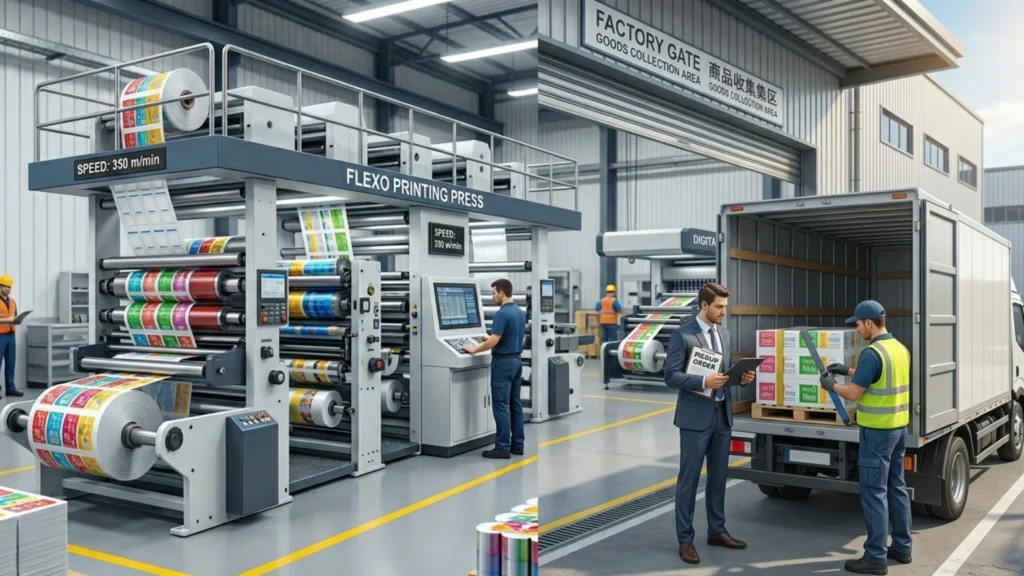
FOB means the supplier is responsible for delivering machinery to the named port of origin and loading it onto the vessel. From that point, the buyer assumes full risk and cost.
FOB China machinery shipping terms are the most practical choice for the majority of incoterms machinery buyers. The seller handles what they know best, export clearance and domestic Chinese transport, while the buyer controls the largest single cost in the chain: ocean freight.
Advantages of FOB
- Balanced split of responsibility between seller and buyer
- Seller manages complex China export procedures and documentation
- Buyer retains full control over ocean freight selection and cost
Disadvantages of FOB
- The buyer still needs to source competitive freight rates independently
- Risk transfers at the loading port, so any vessel-loading damage becomes the buyer’s liability
FOB China machinery shipping terms are particularly effective because export procedures in China carry specific requirements around documentation, port fees, and customs declarations. Letting the supplier manage that side while the buyer controls ocean freight is a practical and cost-efficient arrangement. Most experienced Incoterms machinery buyers default to FOB for shipments above a certain volume threshold.
CIF Explained for Machinery Buyers
CIF shipping, meaning machinery import, is frequently misread as a fully inclusive delivered price. It is not. The seller selects the freight provider and sets the rate, which means Incoterms machinery buyers using CIF have limited visibility into what they are actually paying for shipping, and suppliers sometimes mark up freight costs.
Advantages of CIF
- Simpler for buyers who are new to incoterms China machinery import processes
- Reduces logistics management on the buyer’s side significantly
- Practical when you have no established freight forwarder relationship in China
Disadvantages of CIF
- Lower cost transparency in freight markups by the seller is common and hard to detect
- Basic insurance may not be sufficient for high-value machinery shipments
- Harder to benchmark shipping costs across multiple suppliers
CIF shipping, meaning machinery import, is best understood as a convenience term; you trade cost control for simplicity. For first-time incoterms machinery buyers, CIF reduces complexity. For experienced buyers moving volume, FOB almost always delivers better value.
EXW vs FOB vs CIF: Key Differences
| Term | Responsibility | Cost Control | Risk Level for Buyer |
| EXW | Full buyer control from the factory | High | High |
| FOB | Shared at the port of loading | Medium | Medium |
| CIF | Seller handles freight to the destination port | Low | Medium |
EXW vs FOB vs CIF explained at a practical level: EXW gives maximum control and the lowest headline price but demands the most logistics capability from the buyer. FOB is the preferred choice of most experienced importers. CIF is the most convenient but the least transparent in terms of cost. For Incoterms machinery buyers at any experience level, understanding this table before reading any supplier quote is essential.
Which Incoterm Is Best for Machinery Buyers?
FOB is generally the best option for incoterms machinery buyers because it balances cost control and logistics responsibility effectively across most shipment types and sizes.
That said, the right choice depends on your experience, freight partnerships, and order volume. Before deciding on shipping terms, buyers should first choose a machinery manufacturer in China that has proven technical and export capability.
When to Choose EXW
Choose EXW when you have a reliable freight forwarder already operating in China, want to compare EXW factory price China machinery quotes on an equal footing across suppliers, and have the logistics capacity to manage export clearance independently. EXW vs FOB vs CIF explained for advanced buyers often ends here; experienced importers frequently prefer EXW for maximum control.
When to Choose FOB
FOB China machinery shipping terms work best for most mid-to-large machinery shipments. The seller handles China-side complexity, and the buyer controls the ocean freight, the highest variable cost. Most Incoterms machinery buyers with at least one or two import cycles under their belt should default to FOB.
When to Choose CIF
CIF shipping, meaning machinery import, makes the most sense for first-time importers, smaller or lower-value orders, or situations where logistics simplicity takes priority. Always request an itemized freight cost breakdown to verify the rate is fair before accepting CIF terms.
Hidden Costs Buyers Don’t Know in Incoterms
One of the biggest traps for Incoterms machinery buyers is assuming the quoted price reflects the full cost. Transit times and port charges vary significantly when shipping heavy machinery from China, making accurate landed cost calculations essential. Here are charges that regularly appear after the fact:
- Local transport charges in China: under EXW factory price China machinery terms: moving equipment from an inland factory to a coastal port can add $800–$2,000 or more, depending on distance and machinery size
- Port handling and terminal fees: these vary by port and are frequently excluded from quoted freight rates
- Export customs clearance costs: under EXW, the buyer pays for this; under FOB and CIF, the seller covers it
- Insurance gaps: CIF shipping meaning machinery import includes only minimum coverage; additional marine insurance is advisable for high-value equipment
- Documentation fees: certificates of origin, packing lists, and commercial invoices all carry processing fees
- Destination port charges: demurrage, container detention, and unloading fees that begin the moment the vessel docks
Common Mistakes Machinery Buyers Make
Even seasoned incoterms machinery buyers fall into predictable traps. These are the most expensive ones.
Comparing an EXW factory price China machinery quote directly against a FOB price without calculating the full logistics chain is the single most common mistake. The EXW number is always lower until you add inland freight, export clearance, port handling, and documentation. At that point, the FOB quote often costs the same or less with far less hassle.
Not verifying CIF freight rates against independent market benchmarks is another frequent oversight. CIF shipping, meaning machinery import, gives the seller full control over freight selection, and a markup of 10–20% above market rate is common and difficult to detect without comparison.
Other costly mistakes include ignoring insurance coverage gaps on high-value shipments, failing to confirm shipping responsibilities in the written purchase contract, choosing shipping terms without a logistics plan in place, and accepting whatever incoterm the supplier proposes without negotiating.
For incoterms machinery buyers, every one of these mistakes is avoidable with the right knowledge and the right partners.
Real Example: EXW vs FOB Cost Difference
Consider a hydraulic press quoted at $36,000 EXW factory price China machinery from a factory in Shandong province.
On paper, it looks competitive. But add $1,400 for inland truck transport to Qingdao port, $650 for export customs clearance, $320 for documentation and terminal handling, and $3,600 for ocean freight to Rotterdam, and the total reaches $41,970 before it arrives at the destination port.
Now compare that to a FOB Qingdao quote of $38,200 for the same machine, with the same $3,600 ocean freight total: $41,800. The difference is just $170, but the FOB option requires significantly less logistics management and carries less risk for the buyer.
EXW vs FOB vs CIF explained through real numbers makes the point better than any definition. Incoterms machinery buyers who calculate landed cost before deciding always make smarter choices than those who compare headline prices alone.
Role of a Machinery Sourcing Agent in Incoterms
Navigating China’s machinery import processes using Incoterms without local expertise puts buyers at a serious disadvantage. A qualified machinery sourcing agent like Kingsler Machinery removes that disadvantage at every stage.
Kingsler Machinery helps Incoterms machinery buyers choose the correct term for their shipment size, machinery type, and destination. They verify freight rates against current market benchmarks, which is particularly important when evaluating CIF shipping, meaning machinery import quotes from suppliers. They coordinate the full logistics chain from factory to port, manage export customs documentation under FOB China machinery shipping terms, and ensure the EXW factory price China machinery quote you received actually reflects what you will pay once logistics are added.
For incoterms China machinery import at any scale, having an experienced sourcing partner means fewer surprises, lower total landed costs, and contracts that clearly define who is responsible for what.
Avoid expensive sourcing mistakes with expert support from Kingsler Machinery. Always verify suppliers, pricing, and shipping terms before confirming any machinery order.
Best Practices for Choosing Incoterms
Incoterms machinery buyers who consistently get shipping terms right share a few common habits.
They always calculate total landed cost, never compare an EXW factory price China machinery quote against an FOB quote at face value. They request a full cost breakdown from every supplier, including all domestic charges, port fees, and documentation costs. They confirm responsibilities in writing within the purchase contract, specifying the exact incoterm, named port, and any agreed deviations. And they work with trusted logistics partners who have established relationships with Chinese freight forwarders and destination customs brokers.
Following FOB China machinery shipping terms consistently, verifying CIF shipping meaning machinery import rates independently, and understanding when EXW vs FOB vs CIF explained applies to your specific situation—these habits separate buyers who control their import costs from those who discover them after the fact.
Final Thought
Incoterms are not fine print. For Incoterms machinery buyers, they are the foundation of every cost calculation, every risk assessment, and every contract negotiation in cross-border machinery trade.
The wrong choice or an uninformed one can add thousands of dollars to a shipment that looked profitable on paper. The right choice, made with a clear understanding of EXW vs FOB vs CIF explained in full, puts Incoterms machinery buyers in control of their logistics, their costs, and their supplier relationships.
Whether you are comparing an EXW factory price China machinery quote, evaluating FOB China machinery shipping terms, or trying to decode what CIF shipping meaning for machinery import actually covers, the principle is the same: calculate your total landed cost, confirm responsibilities in writing, and never assume the headline price is the final price. Smart Incoterms China machinery import decisions start before you confirm the order, not after it ships.
Ready to import machinery safely? Get expert guidance from Kingsler Machinery on choosing the right Incoterms and reducing hidden shipping costs.
FAQs
What are Incoterms in machinery import?
Incoterms are standardized international trade rules that define cost, risk, and logistics responsibilities between buyers and sellers. For incoterms machinery buyers determine who pays for freight, insurance, and customs clearance and when risk transfers from seller to buyer.
What is the difference between EXW and FOB?
Under EXW, the buyer handles everything from the factory gate, including inland transport and export clearance. Under FOB, the seller covers export clearance and port delivery, with risk transferring once goods are loaded onto the vessel. EXW vs FOB vs CIF explained simply: EXW gives more control but more complexity; FOB balances both.
Is CIF better for machinery buyers?
CIF shipping means machinery import is easier to manage but offers less cost transparency. The seller arranges freight and basic insurance to the destination port, but buyers have limited visibility into freight rates. CIF suits beginners; FOB suits experienced Incoterms machinery buyers who want cost control.
Which Incoterm is cheapest for importers?
No single term is universally cheapest. EXW factory price China machinery quotes appear the lowest but exclude all logistics costs. Total landed cost under EXW often matches or exceeds FOB once all charges are calculated. The cheapest option depends on your freight relationships and logistics capacity.
Who pays shipping in FOB terms?
Under FOB China machinery shipping terms, the seller pays for inland transport and export clearance in China. The buyer pays for ocean freight, marine insurance, import duties, and all destination port charges.
What is the safest Incoterm for beginners?
CIF is the most hands-off starting point for first-time incoterms China machinery import buyers. DAP and DDP offer even more seller coverage. For most beginners, CIF or FOB with a reliable freight forwarder offers the best balance of safety and manageable cost control.