


Blogs
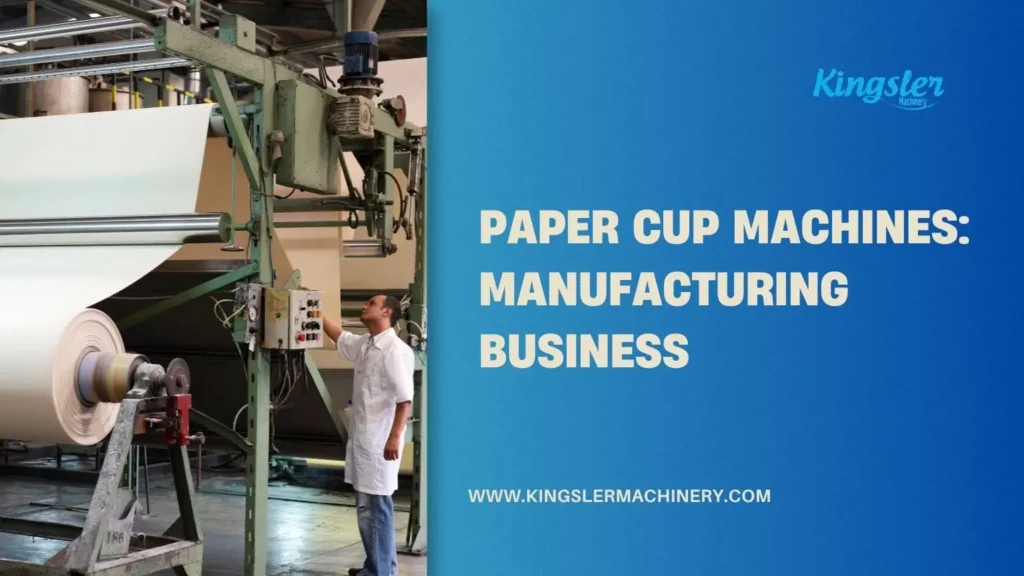
Paper cup manufacturing has become one of the more accessible entry points into industrial production. This paper cup making machine guide shows you exactly what’s needed. As plastic bans expand across Asia, Europe, and North America, demand for disposable paper cups continues to grow across food service, healthcare, and retail sectors. The business opportunity is real, but the machines you start with determine everything. Your output volume, product quality, labor cost, and profit margin all flow directly from this one decision. Getting it right separates a scalable operation from one that struggles. This paper cup making machine guide from Kingsler Machinery will pave the way to success for your business.
What Is a Paper Cup Manufacturing Business?
A paper cup manufacturing business produces disposable drinking cups from food-grade paperboard, supplying the beverage, food service, and packaging industries. The operation takes large rolls of coated paper, processes them through a production line, and delivers finished cups ready for distribution.
What makes this business work at scale is automation. Paper cup production is almost entirely machine-driven, meaning a small team can manage high-volume output once the line is set up. Buyers expect consistent cup dimensions, leak-proof sealing, and clean printing, all delivered reliably by automated machinery. Understanding paper cup manufacturing machine types is crucial here. Explore the full paper cup machinery range from the product category page for cup production systems.
Machines You Need to Start a Paper Cup Business
Each machine plays a specific role. Gaps create bottlenecks, quality failures, and wasted material. Refer to this paper cup making machine guide for details on paper cup manufacturing machine types.
Paper Cup Forming Machine
The paper cup forming machine is the heart of the operation. It takes pre-cut paper blanks, rolls them into shape, heat-seals the side seam, inserts and seals the bottom disc, and curls the top rim, all in under a second per cup. Every other machine supports this machine.
Its speed, sealing quality, and accuracy define your output. Poor temperature control produces weak seams that leak, destroying client relationships. Investing in a well-built forming machine from a verified manufacturer is non-negotiable; this paper cup making machine guide stresses it.
Printing Machine
A printing machine applies branding, logos, and text to paper before forming. Flexographic printing is most common, using food-safe inks that dry quickly.
In-house printing is a significant advantage. Clients require branded cups; it’s rarely optional. Controlling printing means faster turnaround, better color accuracy, and a higher selling price. Your paper cup making machine guide covers printing essentials.
Die Cutting Machine
A die-cutting machine stamps flat paperboard into the precise fan-shaped blanks the forming machine needs. Every blank must be identical; even millimeters of inconsistency cause misaligned seams.
Beyond accuracy, a quality die cutter gives production flexibility. Changing the die allows switching between cup sizes without separate stock. This paper cup making machine guide explains die cutting.
Packaging Machine
A packaging machine counts, stacks, wraps, and seals finished cups into retail-ready units automatically. Hygienically sealed, correctly counted packaging is a buyer requirement.
Automating this stage ensures packaging speed matches production speed. This paper cup making machine guide includes packaging details.
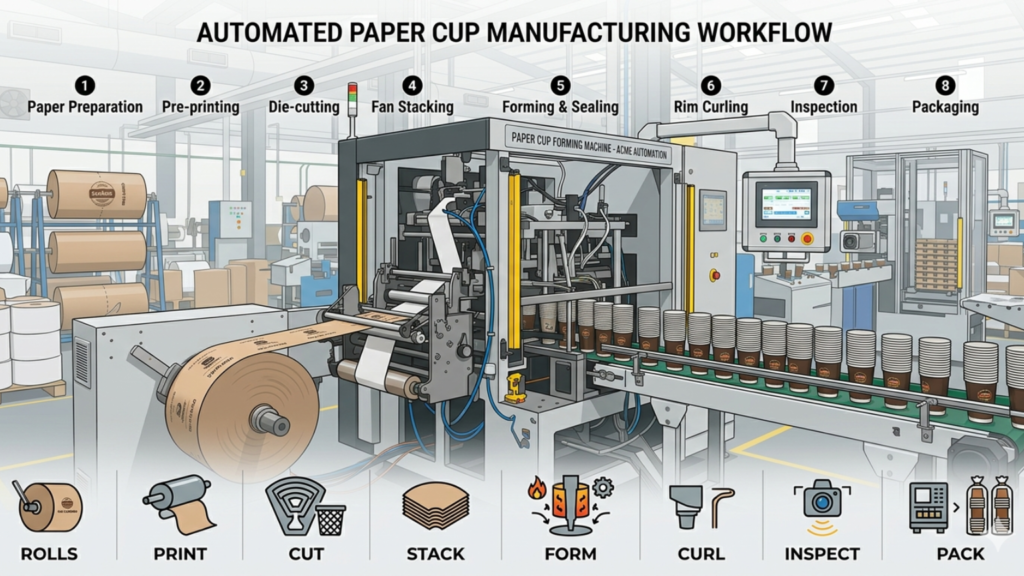
Paper Cup Production Process
Production begins with large rolls of PE-coated food-grade paperboard loaded onto an unwinding station. The coating makes the cup liquid-resistant.
The paper feeds into the printing machine, where branding is applied at the correct orientation. Ink is cured with UV or hot air, so the paper moves straight to the next stage.
From printing, the sheet enters the die-cutting machine, stamping out fan-shaped blanks at high speed. Waste offcuts are baled for recycling. Cut blanks feed into the forming machine, where each is rolled, side-seamed, bottom-sealed, and rim-curled into a finished cup.
Finished cups pass quality inspection before the packaging machine counts and seals them. Packed cups move to storage, then palletized and dispatched. A complete paper cup production line setup follows this flow. Your paper cup making machine guide details this setup.
How to Choose the Right Machine Setup
The right setup depends on production targets, operational model, and budget. No universal answer exists; a small supplier needs a different line than a national manufacturer. Consult this paper cup making machine guide.
Based on Production Capacity
Match your machine to realistic daily output:
- Small-scale: 10,000–30,000 cups/day, suited for local markets
- Medium-scale: 50,000–150,000 cups/day, for regional distribution
- Large industrial: 300,000+ cups/day for national supply or export
Based on Automation Level
Automation determines labor cost, output consistency, and growth ceiling:
- Manual: lowest cost, high operator involvement, best for testing
- Semi-automatic: operator loads material, and the machine forms, and seals
- Fully automatic: minimal labor, consistent high-speed output, lowest cost-per-cup
Many seek automatic paper cup machine China suppliers for better pricing. This paper cup making machine guide covers automation.
Based on the budget
Capital sets your setup boundary:
- Low investment: USD 15,000–40,000 for entry-level semi-automatic
- Mid-range: USD 50,000–120,000 for capable semi-automatic or entry-level automatic
- Industrial: USD 150,000+ for high-speed fully automatic lines
For small operations, the small paper cup-making machine cost ranges from USD 15,000 to 40,000. Your paper cup making machine guide covers the budget.
Cost of Starting a Paper Cup Business
Machine cost is your largest upfront expense: USD 20,000 for basic semi-automatic machines to USD 200,000+ for high-speed automatic machines. Machine price rarely includes installation, training, or spare parts; negotiate these before signing.
Raw material cost is your biggest ongoing expense. The food-grade PE-coated paperboard price fluctuates with global markets. Locking in volume pricing early impacts profitability. Follow this paper cup business setup guide.
Labor cost is tied to the automation level. Semi-automatic requires 3–5 operators per shift; fully automatic runs with 1–2 operators per shift. In markets with rising wages, higher automation upfront is more cost-effective.
Maintenance costs are underestimated. Forming machines run under constant heat and stress; wearing parts need regular replacement. Budget 3–5% of the machine value annually for parts. Your paper cup making machine guide covers maintenance. Also, the PCPM-0001 Paper Cup Packaging Machine provides customized intelligent control features while providing reliability and meets diverse industrial requirements for expansion and quality optimization.
Common Mistakes Buyers Make
Avoid these mistakes before investing:
- Wrong machine speed: Real output is 30–40% lower than peak rated speed. Never plan financials around maximum.
- Ignoring maintenance costs: Cheap machines wear faster, cost more in repairs, and result in downtime.
- Poor capacity planning: Too small limits growth; too large inflates cost per cup.
- Skipping supplier verification: Unverified suppliers may deliver wrong specs or provide no support.
Using a disposable cup manufacturing machine from verified suppliers prevents issues. This paper cup making machine guide warns against mistakes.
Final Takeaway
The machines you invest in are the foundation of your business’s ability to grow. Production quality, client retention, and scalability connect back to this decision. Businesses starting with well-matched machinery from verified suppliers build more predictably and profitably.
For buyers sourcing from China, where most paper cup machine manufacturing is based, working with a professional sourcing agent reduces risky mistakes. This paper cup making machine guide helps you choose.
Your paper cup-making machine guide ensures you select the right one. Follow this paper cup business setup guide for success. This paper cup production line setup guide completes your knowledge.
Ready to build your paper cup manufacturing line with Kingsler Machinery? Contact our sourcing team for verified supplier recommendations, transparent pricing, and end-to-end procurement support.
FAQs
What machines are needed for paper cup manufacturing?
The four core machines are the forming machine, die cutting machine, printing machine, and packaging machine. The forming machine is most critical. This paper cup making machine guide confirms it.
How much does a paper cup machine cost?
Entry-level semi-automatic: USD 15,000–40,000. Mid-range automatic: USD 50,000–120,000. High-speed industrial: USD 150,000+. The cost of a small paper cup-making machine starts at USD 15,000.
Is paper cup manufacturing profitable?
Yes, when machine setup matches market demand and costs are managed. Supplying branded cups achieves stronger margins. Your paper cup business setup guide confirms profitability.
Which machine is best for beginners?
A mid-range semi-automatic forming machine is most practical. It offers manageable cost, straightforward operation, and sufficient output. This paper cup making machine guide recommends it.
What is the production capacity of paper cup machines?
Capacity ranges from 10,000 cups/day (small manual) to 300,000+ cups/day (high-speed automatic). A paper cup production line setup affects actual output.