


Blogs
Canton Fair Phase 1 runs twice a year: April 15 to 19 for the Spring 2026 session and October 15 to 19 for Autumn 2026, both held at the China Import and Export Fair Complex in Guangzhou. It’s the industrial opening stage of the fair, the five days when the largest concentration of Chinese equipment manufacturers gather under one roof before the show shifts into consumer goods and textiles in the phases that follow.
For anyone sourcing Canton Fair industrial equipment, that makes Phase 1 the only stretch of the fair worth building a trip around. This guide walks through what you actually need before you land: dates, hall layout, machinery categories, registration, and practical tips that make the difference between a productive trip and a wasted one.
| Quick Answer: Canton Fair Phase 1 is the machinery and industrial equipment stage of China’s largest trade fair, held April 15–19 and October 15–19, 2026, in Guangzhou. It covers general machinery, construction and agricultural equipment, processing machinery, hardware, and industrial automation, making it the phase to attend for anyone sourcing production machinery from China. |
What Is Canton Fair 2026 Phase 1?
Canton Fair Phase 1 is the opening stage of the China Import and Export Fair, held every spring and autumn in Guangzhou. Each edition of the fair runs across three phases over roughly three weeks, and Phase 1 is officially themed around “advanced manufacturing.”
It’s the industrial and technology stage of the show, covering machinery, hardware, electronics, and vehicles, before the fair shifts into home goods in Phase 2 and textiles and consumer products in Phase 3.
Why Phase 1 Matters for Machinery & Industrial Equipment
The exhibitor floor here stays dense with actual equipment manufacturers rather than gift suppliers or garment factories. For machinery buyers, that makes a real difference:
- More factory-direct suppliers, since the phase leans toward manufacturers over trading companies
- Less wasted time, since Phase 2 and Phase 3 shift into categories with little crossover for machinery buyers
- Easier comparison, with most industrial exhibitors grouped into a single phase instead of split across sessions
The scale backs this up. A recent spring session alone drew 148,585 overseas buyers from 216 countries to Phase 1, a year-on-year jump of more than 20 percent, which makes it the largest single gathering of Chinese equipment manufacturers anywhere in the world.
Canton Fair Phase 1 Dates & Location
Canton Fair Phase 1 runs twice a year, once in spring and once in autumn, always as a fixed five-day window at the start of the fair. Here’s exactly when and where to show up for 2026:
| Session | Dates | Hours |
| Spring 2026 | April 15 to 19, 2026 | 9:30 AM to 6:00 PM |
| Autumn 2026 | October 15 to 19, 2026 | 9:30 AM to 6:00 PM |
Location (same for both sessions): China Import and Export Fair Complex (Pazhou Complex), No. 380–382 Yuejiang Middle Road, Haizhu District, Guangzhou
The venue sits directly on Pazhou Station, served by Metro Line 8 and Line 11, making it easy to reach from most hotels in Guangzhou. Both sessions run the same five-day Phase 1 window and feature the same machinery and industrial equipment categories, so buyers can plan around whichever dates fit their schedule without missing out on product variety.
Canton Fair 2026 Phase 1 Product Categories & Hall Map
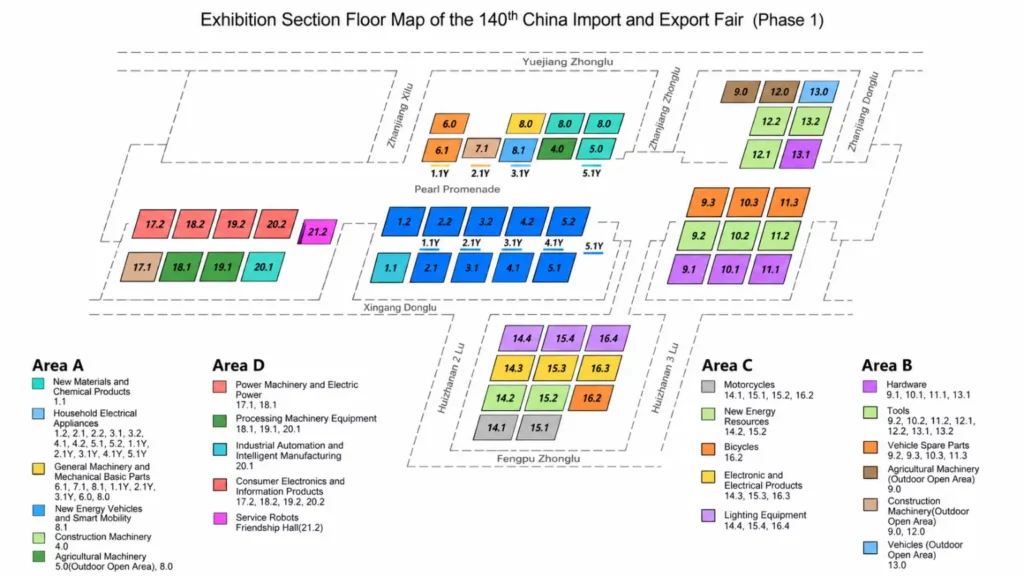
Canton Fair Phase 1 products span four zones, Areas A, B, C, and D, each grouping a specific set of exhibitor categories with their own hall and booth numbers. Here’s exactly what’s in each zone:
Area A
| Category | Hall / Booth Numbers |
| New Materials and Chemical Products | 1.1 |
| Household Electrical Appliances | 1.2, 2.1, 2.2, 3.1, 3.2, 4.1, 4.2, 5.1, 5.2, 1.1Y, 2.1Y, 3.1Y, 4.1Y, 5.1Y |
| General Machinery and Mechanical Basic Parts | 6.1, 7.1, 8.1, 1.1Y, 2.1Y, 3.1Y, 6.0, 8.0 |
| New Energy Vehicles and Smart Mobility | 8.1 |
| Construction Machinery | 4.0 |
| Agricultural Machinery | 5.0 (Outdoor Open Area), 8.0 |
Area B
| Category | Hall / Booth Numbers |
| Hardware | 9.1, 10.1, 11.1, 13.1 |
| Tools | 9.2, 10.2, 11.2, 12.1, 12.2, 13.1, 13.2 |
| Vehicle Spare Parts | 9.2, 9.3, 10.3, 11.3 |
| Agricultural Machinery | 9.0 (Outdoor Open Area) |
| Construction Machinery | 9.0, 12.0 (Outdoor Open Area) |
| Vehicles | 13.0 (Outdoor Open Area) |
Area C
| Category | Hall / Booth Numbers |
| Motorcycles | 14.1, 15.1, 15.2, 16.2 |
| New Energy Resources | 14.2, 15.2 |
| Bicycles | 16.2 |
| Electronic and Electrical Products | 14.3, 15.3, 16.3 |
| Lighting Equipment | 14.4, 15.4, 16.4 |
Area D
| Category | Hall / Booth Numbers |
| Power Machinery and Electric Power | 17.1, 18.1 |
| Processing Machinery Equipment | 18.1, 19.1, 20.1 |
| Industrial Automation and Intelligent Manufacturing | 20.1 |
| Consumer Electronics and Information Products | 17.2, 18.2, 19.2, 20.2 |
| Service Robots, Friendship Hall | 21.2 |
For machinery buyers, Areas A, B, and D carry almost everything you need. General machinery, construction equipment, and new energy vehicles sit in Area A. Hardware, tools, and the outdoor-displayed construction and agricultural machinery, the largest equipment on the floor, sit in Area B.
Processing machinery, power equipment, and automation sit in Area D. Area C is mostly relevant if you’re also sourcing motorcycles, bicycles, or lighting alongside your machinery list.
Category placement can shift slightly session to session, so it’s worth double-checking Canton Fair Phase 1 exhibitor categories against the current session’s directory before you finalize your route.
Machinery & Industrial Equipment Categories at Phase 1
Canton Fair Phase 1 machinery is the part that matters most, so let’s break it down by what’s actually on the floor rather than a vague “machinery” label.
Processing and Manufacturing Machinery
Injection molding machines, extrusion lines, CNC equipment, printing and packaging machinery, and food and beverage processing lines. This is the largest single cluster at Phase 1, and most exhibitors here are factory-direct rather than trading companies, which usually means sharper pricing and more accurate specs.
Buyers focused on packaging tend to spend the most time here, since this is also where paper bag making machines and similar production lines get compared side by side before an order is placed.
General Machinery and Mechanical Basic Parts
Bearings, gears, motors, pumps, valves, and other core mechanical components that feed into larger equipment builds. Useful for buyers sourcing parts rather than complete machines, whether for new builds or maintenance on existing equipment.
Construction Machinery
Excavators, loaders, cranes, concrete equipment, and other heavy-duty construction gear. Much of it sits in the outdoor open-air sections rather than inside a hall, given the size of the equipment on display, so budget extra walking time to reach it.
Agricultural Machinery
Tractors, harvesters, irrigation systems, and farm processing equipment. This category serves both large-scale agribusiness buyers and smaller distributors, and like construction machinery, much of the larger equipment is displayed outdoors.
Power Machinery and Electric Power Equipment
Generators, transformers, motors, and power distribution equipment, drawing buyers from utilities, industrial facilities, and construction projects needing reliable power supply solutions.
Industrial Automation and Intelligent Manufacturing
Robotics, PLCs, sensors, and automated production line components, plus a dedicated service robots zone. This is one of the fastest-growing sections at the fair as more factories shift toward automated output.
Hardware and Tools
Power tools, hand tools, welding equipment, and fasteners sit alongside the heavier machinery halls and are often the fastest category to source from, given how standardized much of it is.
Looking for a specific machine type? Contact our team and we’ll help match you with verified manufacturers before you even land in Guangzhou.
How to Get Your Buyer Badge and Register
Canton Fair Phase 1 registration requires an overseas buyer badge to enter the complex, and it’s free of charge no matter how you apply for it. For the latest official details on Phase 1’s exhibition scope and highlights, the Chinese Ministry of Commerce publishes session updates ahead of each fair.
Online Registration Steps
- Go to the official Canton Fair website and open the Buyer E-Service Tool (BEST), or use the Canton Fair app
- Select “Overseas Buyer” and create your account with your business license or company registration
- Choose your sourcing categories, machinery, and industrial equipment specifically, so the platform’s matchmaking tool can start suggesting relevant suppliers before you arrive
- Download your electronic invitation letter, required for visa applications
- Print your badge confirmation, or collect the physical badge once in Guangzhou
Once registered, download the Canton Fair app or exhibitor directory to search machinery booths by keyword ahead of time; it maps every relevant listing to its exact hall and aisle, saving hours compared to walking the floor cold. Buyers who can’t make the trip themselves often lean on a sourcing agent based in China to follow up with shortlisted suppliers instead.
Badge Pickup, If You Didn’t Print in Advance
Badges can be collected off-site before you even reach the venue, at Guangzhou Baiyun International Airport, Guangzhou South Railway Station, the Pazhou ferry terminal, and a number of designated hotels around the city, in addition to the on-site registration offices at the complex itself.
Visa Requirements
Most overseas buyers need a Chinese business visa (M visa) to attend, for which the invitation letter from BEST is a required document. China has also expanded visa-free entry for citizens of a growing number of countries for stays of up to 30 days, so check current entry requirements with your nearest Chinese consulate before booking travel, since eligibility varies by nationality and changes periodically.
Can’t Travel? The Online Option
If you can’t make it to Guangzhou in person, Canton Fair also runs a parallel online platform alongside each offline session, typically open for around six months per edition. It carries the same exhibitor listings and product categories as the physical fair, though for machinery specifically, an in-person visit or a remote factory audit is still the better way to confirm build quality before you commit.
Where to Stay: Accommodation Near the Venue
Hotel planning matters more than most first-time buyers expect, and machinery sourcing trips often need more flexibility than a typical fair visit. Factory follow-ups, supplier video calls, and inspection visits frequently run beyond the five official fair days, so it’s worth booking a few extra nights rather than cutting it tight. Rooms near the Pazhou Complex routinely sell out six to twelve months ahead of each session, and rates during fair week commonly run three to five times higher than normal.
Best Areas to Base Yourself
- Haizhu District (Pazhou Island): closest to the venue, and the most convenient choice if most of your target booths sit in Area B or Area D, where the bulk of machinery, hardware, and processing equipment halls are
- Tianhe District: a bit further out but well connected via Metro Line 8, with a wider range of hotel options and price points
- Zhujiang New Town: Guangzhou’s central business district, useful if you’re also coordinating factory visits or meetings with a sourcing agent beyond the fair itself
Whichever area you choose, prioritize a hotel directly on Metro Line 8 or Line 11, since that single line carries the bulk of fair traffic each morning and evening.
Getting to the Venue
Most international buyers land at Guangzhou Baiyun International Airport, which connects to Pazhou via Metro Line 3 then Line 8, roughly 45 to 60 minutes depending on your hotel. Downloading the Canton Fair Phase 1 map before you land makes navigating from the metro exit to your first hall much faster.
A taxi takes a similar amount of time and costs somewhere in the range of RMB 120 to 150. If you’re coming from Hong Kong, the Pazhou ferry terminal offers a direct route into the venue area without needing to transit through central Guangzhou.
Getting the Most Out of a Machinery Sourcing Trip
Walking the machinery halls without understanding the Canton Fair Phase 1 layout is the single biggest mistake first-time buyers make. A few things that actually move the needle:
- Bring specs, not descriptions. Exact numbers, capacity, size, and output speed get accurate quotes. Vague requests get vague ones.
- Confirm you’re talking to the factory. Many booths are trading companies representing several manufacturers, so it’s worth checking a supplier’s background before you request a video call or commit to anything sizable.
- Walk the full subcategory first. Exhibitors are grouped by product type, so compare three or four suppliers in the same aisle before deciding.
- Factor in freight early. Industrial machinery is heavy and often needs custom crating, and getting heavy equipment shipped out of China takes longer to arrange than most buyers expect. Get a quote before finalizing your order, not after.
- Pace yourself. With roughly 80 to 120 booths coverable a day, five solid conversations beat fifty rushed ones.
- Skip opening and closing day if you can. These draw the heaviest crowds and the shortest conversations.
- Prepare for language gaps. Keep specs written down rather than relying on conversation, and set up WeChat before you arrive since it’s the standard way suppliers follow up.
None of these tips are complicated on their own, but together they’re the difference between leaving with a stack of business cards and leaving with real, comparable quotes you can actually act on.
Final Thoughts
Canton Fair Phase 1 is the closest thing the machinery world has to a single, physical marketplace, where you can walk from a construction equipment booth to a packaging machinery line to an automation supplier in the same afternoon. No online sourcing platform lets you compare build quality and negotiate face to face at this scale in five days.
The buyers who get the most out of it show up with a plan: exact specs in hand, a shortlist of halls to hit first, and accommodation booked well ahead of time. Do that, and Phase 1 becomes exactly what it’s meant to be, the fastest way to find and vet real machinery manufacturers in China.
Need help sourcing machinery from China? Kingsler Machinery helps buyers verify suppliers, inspect equipment, and manage logistics after the fair.
Frequently Asked Questions
When is Canton Fair Phase 1 in 2026?
Canton Fair Spring Phase 1 runs twice a year. The first one was during the spring of April 15 to 19, 2026, and the next one is during autumn, which runs from October 15 to 19, 2026.
What machinery is exhibited at Canton Fair Phase 1?
The machinery exhibited at the Canton Fair Phase 1 are processing and manufacturing machinery, construction machinery, agricultural machinery, general machinery and mechanical parts, power equipment, industrial automation, and hardware & tools.
What’s the difference between Canton Fair Phase 1 and Phase 2?
Phase 1 covers machinery, electronics, hardware, and vehicles. Phase 2 shifts into consumer goods: home decor, gifts, furniture, and building materials. Machinery buyers only need Phase 1.
Is Canton Fair Phase 1 free to attend?
Yes. The overseas buyer badge is free of charge whether you register online in advance or apply on-site, though pre-registering saves significant time in queues.
Where is Canton Fair Phase 1 held?
The Canton Fair Phase 1 is held at the China Import and Export Fair Complex (Pazhou Complex), No. 380–382 Yuejiang Middle Road, Haizhu District, Guangzhou, directly accessible via Pazhou Station on Metro Line 8 or Line 11.
Do I need a visa to attend Canton Fair Phase 1?
Most international buyers need a Chinese business visa (M visa), for which your electronic invitation letter from the Buyer E-Service Tool (BEST) is required. Some nationalities may qualify for visa-free entry for short stays, so confirm current rules with your nearest Chinese consulate before booking.
How far in advance should I book a hotel?
Rooms near the Pazhou Complex often fill up six to twelve months ahead of each session, with rates during fair week running three to five times higher than normal, so book as early as your travel plans allow.
How do I know if a machinery exhibitor is the actual manufacturer?
Ask directly during the booth conversation; many exhibitors are trading companies representing several factories. For any significant equipment purchase, request a factory video call or an in-person visit before placing an order.
Which days of Canton Fair Phase 1 are best for machinery buyers?
The middle two or three days, avoiding the opening and closing days when booths are busiest and supplier conversations get rushed.
Do I need a sourcing agent to attend Canton Fair Phase 1?
Not to attend, but many buyers use one for what comes after: factory verification, quality inspection before shipment, and freight logistics back to their country. A sourcing partner on the ground in China can pick up those steps once the fair itself wraps up.