


Blogs
Full Inspection vs Spot Check: Which Quality Inspection Method Is Right?
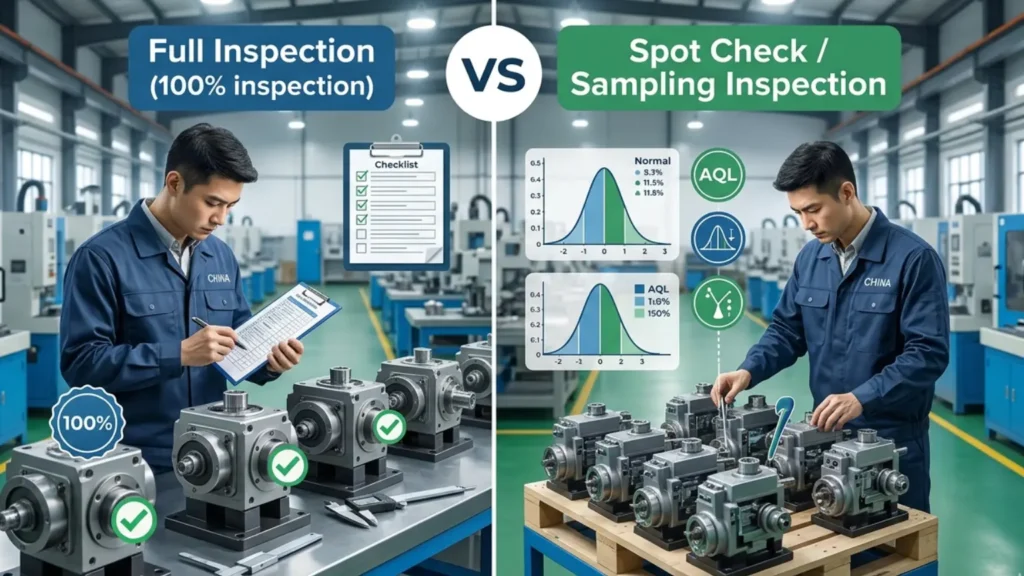
If you’re importing machinery or industrial goods from China, one decision can quietly make or break your order: choosing the right inspection method. Use the wrong one, and defective products slip through, timelines blow up, and customers lose trust.
The two methods you’ll hear about most are full inspection vs spot check. Both exist for good reasons, but they serve very different situations. This guide breaks down how each one works, when to use it, and how to make the right call for your specific order.
What Is Quality Inspection in Manufacturing?
Quality inspection in China is the process of checking products against agreed-upon standards before they leave the factory. This covers dimensions, appearance, function, safety, and packaging, and it can happen at several points in the production process:
- Pre-production: Verifying raw materials and components meet spec before production begins
- During production: Catching issues while goods are still on the line
- Pre-shipment / final inspection: Reviewing finished goods before they’re loaded for export
Each stage catches different kinds of problems. But when most buyers talk about full inspection vs spot check, they’re focused on that last stage, the final check before goods leave China.
For deeper insights on quality control practices during production, check out our guide: Quality Control Tips for Mechanical Machines in China.
What Is Full Inspection?
Full inspection, sometimes called 100% inspection, means every single unit in a batch is checked individually. Not a sample, not a random selection. Every piece goes through the same checklist before it’s approved.
Understanding the full inspection China meaning starts here; it’s the method you use when no defective unit can be allowed through. Each item is evaluated for workmanship, dimensions, function, and packaging. Only units that pass are certified for shipment.
When Full Inspection Makes Sense?
- High-value machinery and industrial equipment
- Critical components where one faulty part causes failures downstream
- Any order where defects were already found in a previous batch
- New suppliers whose quality processes haven’t been verified yet
- Orders with strict safety or compliance requirements
Full inspection is also the right call when there’s any reason to suspect a factory might be mixing defective units into a batch. Checking every piece removes that risk entirely.
What Is Spot Check (Sampling Inspection)?
A spot check, also called sampling inspection, takes a different approach. Instead of checking every product, a random sample is pulled from the batch and inspected. That sample result is then used to decide whether to accept or reject the entire shipment.
Spot check inspection China is the most commonly used approach in manufacturing, and for good reason, because it’s fast, cost-effective, and internationally standardized through the AQL framework. In fact, most buyers sourcing standard goods through spot check inspection China will find it fits well within normal production timelines.
How Does a Spot Check Inspection Work?
- A sample size is calculated based on the total batch quantity and the relevant inspection standard
- Units are randomly selected from across the shipment
- Defects found in the sample are counted and categorized
- The batch is accepted or rejected based on how the defect count compares to the acceptable threshold
Because you’re only checking a portion of the batch, spot checks move much faster and cost significantly less than a full inspection, especially for large-volume orders.
Full Inspection vs Spot Check: Key Differences
When weighing full inspection vs spot check, the differences come down to five core factors:
| Factor | Full Inspection | Spot Check |
| Coverage | 100% products | Sample-Based |
| Cost | High | Low |
| Accurace | Very high | Moderate |
| Speed | Slow | Fast |
| Risk | Lowest | Depends on sampling |
| Use Case | Critical orders | Standard orders |
When to Use Full Inspection
Full inspection is the right call when the consequences of a defect are serious. That includes:
- Machinery and industrial equipment – complex products where functional defects can be costly or dangerous
- High-value orders – where the cost of a faulty batch exceeds the cost of inspection
- Strict compliance requirements – products that need to meet safety or technical standards
- Low-trust supplier situations – when you don’t yet have confidence in a factory’s quality controls
Advantages of Full Inspection
- Catches every defective unit before it ships
- Provides maximum assurance, no statistical guesswork
- Eliminates the risk of defective units hiding within an otherwise acceptable batch
- When buyers ask about full inspection China, meaning in terms of practical outcomes, this is it: zero unknown defects in your shipment
Limitations of Full Inspection
- More time-consuming, particularly for large batches
- Higher cost in labor and inspector time
- Can delay production timelines if issues are found late
When to Use Spot Check Inspection
Spot check inspection China works well when your product risk is lower and your supplier relationship is established. Good use cases include:
- Bulk orders of consistent, well-defined products
- Repeat orders from a supplier with a proven quality track record
- Low-risk consumer goods where minor occasional defects are commercially manageable
- Time-sensitive shipments where inspection speed matters
Advantages of Spot Check
- Much more cost-effective for high-volume orders
- Faster turnaround, less impact on shipping timelines
- Internationally standardized, making results easy to interpret and act on
Limitations of Spot Check
- Cannot guarantee zero defects; it’s inherently statistical
- May miss functional or hidden defects that don’t show up in the sample
- Only as reliable as the sampling process itself
Not sure which method your order actually needs? Contact Kingsler Machinery for a tailored quality inspection plan built around your product and supplier.
AQL Inspection vs Full Inspection: Understanding the Standard
One of the most important concepts in this space is AQL, the Acceptable Quality Limit. When buyers compare AQL inspection vs full inspection, they’re really asking, Can sampling give me enough confidence, or do I need to check everything?
AQL is defined under ISO 2859-1, the international standard that governs sampling-based inspections globally. It answers two questions every inspector needs to know:
- How many units should be sampled from this batch?
- How many defects are acceptable before the batch fails?
AQL thresholds are set differently depending on defect severity. Critical defects, those that create safety hazards or make a product unusable, carry an AQL of zero. Major defects (product doesn’t function as intended) and minor defects (cosmetic issues) each carry higher tolerances.
The key thing to understand about this comparison is that AQL is a risk-management tool. It’s statistically sound and trusted globally, but it does not guarantee a defect-free shipment. It tells you that, within an acceptable probability range, the batch meets your quality standard. For low-risk products, that’s usually enough. For high-value or complex machinery, it often isn’t, and full inspection becomes the safer choice.
You can review the official ISO 2859-1 sampling standard at the International Organization for Standardization (ISO), the globally recognized body that defines these procedures.
Full Inspection vs Spot Check for Machinery Sourcing in China
When it comes to machinery sourcing from China, the full inspection vs spot check question carries more weight than it does for standard consumer goods. Machinery isn’t a simple product. It involves moving parts, electrical systems, hydraulic components, and precision-machined tolerances. A sampling approach might confirm that visible quality looks fine, but it can easily miss:
- Functional defects that only appear under load or during operation
- Internal component failures not visible on the outside
- Assembly errors in complex sub-systems
- Non-compliant or substituted materials
Understanding the full inspection China meaning in a machinery context means recognizing that 100% inspection isn’t excessive, it’s often the baseline. The cost of a thorough pre-shipment inspection is almost always lower than the cost of receiving a batch of faulty machines, processing returns, and managing the fallout with your customer.
If you want to explore advanced options like remote checks or third-party involvement, learn more about factory verification services in China.
Common Mistakes Buyers Make Around Inspection
A few patterns come up repeatedly when buyers get the inspection wrong:
Defaulting to spot check for high-risk products: It’s cheaper in the short term, but the calculation changes quickly when a bad batch arrives. When looking at product inspection methods China buyers use for machinery and safety-critical parts, full inspection is clearly the right call, yet buyers still skip it to cut costs.
Skipping inspection entirely: Trusting a supplier’s self-certification or a factory audit alone is not inspection. It’s one of the highest-risk decisions in quality inspection China sourcing, especially with new or unverified factories.
Not understanding what AQL actually allows: Many buyers agree to an AQL level without understanding the defect tolerance they’ve accepted. The difference between AQL inspection vs full inspection isn’t just the method; it’s the statistical exposure you’re agreeing to take on.
Choosing purely based on cost: The inspection method should follow product risk, not budget. The U.S. Consumer Product Safety Commission (CPSC) provides import safety guidance for businesses that reinforces that proper inspection is a compliance responsibility, not just a best practice.
How to Choose Between Full Inspection and Spot Check
A straightforward decision framework:
- High risk: Machinery, critical parts, new suppliers, previous defects found → Full inspection
- Medium risk: Standard products, semi-established suppliers, moderate order value → AQL sampling inspection
- Low risk: Repeat orders, trusted suppliers, simple consumer goods → Spot check
The goal in any full inspection vs spot check decision is to match the intensity of your inspection to the actual risk of your order. There is no universal right answer, only the right answer for your specific situation.
The product inspection methods China manufacturers accommodate most full inspection, AQL sampling, and pre-shipment checks exist because different orders carry different risk profiles. Never let cost be the only variable in that equation. Across all product inspection methods China sourcing professionals use, the right method is always the one matched to your actual risk level.
The Role of a China Sourcing Agent in Quality Inspection
Knowing which inspection method to use is only half the challenge. Executing it properly on the ground in China is the other half.
A professional China sourcing agent handles the full process from start to finish, selecting the right method, coordinating with inspectors, reviewing reports, and managing any issues that surface before goods are shipped. This includes:
- Supplier verification before purchase orders are placed
- Inspection coordination at the correct production stage
- Detailed quality reporting with photos and clear pass/fail outcomes
- Issue resolution when defects are discovered before goods leave the factory
The Wikipedia article on quality control gives a solid overview of the broader discipline, but applying it well in a Chinese manufacturing context requires local expertise, established factory relationships, and the ability to act quickly when something goes wrong.
That’s exactly what an experienced sourcing agent brings and why quality inspection China outcomes tend to be significantly better when managed by a trusted third party rather than left to the factory itself.
Full Inspection vs Spot Check: Final Takeaway
The full inspection vs spot check debate comes down to one thing: How much risk can your order actually absorb?
Full inspection gives you complete control. Every unit is checked, every defect is caught before shipment, and you know exactly what you’re receiving. It costs more and takes longer, but for machinery, high-value goods, or any situation where defects carry serious consequences, it’s the right investment.
Spot check inspection gives you speed and cost efficiency. For bulk standard products from reliable suppliers, AQL-based sampling is statistically sound and globally trusted. It works well when the stakes are manageable.
The simplest version of full inspection vs spot check uses the method your product risk demands, not the one your budget prefers. Every experienced professional in quality inspection China will tell you the same thing: the cost of getting inspection wrong almost always exceeds the cost of getting it right.
Ready to get the inspection right on your next machinery order? Get expert quality inspection support from Kingsler Machinery and ship with confidence.
FAQs
What is a full inspection?
Full inspection checks 100% of units in a batch. Use for high-value or safety-critical products. Zero defect tolerance.
What is spot check inspection?
Spot checks inspect a random sample. The result decides acceptance or rejection of the whole batch. Faster and lower cost.
What is AQL in quality inspection?
ISO 2859-1 defines sample size and defect limits. Suitable for standard products, not zero-defect.
When should I use a full inspection?
Use for high-value machinery, safety-critical parts, new suppliers, or after past quality issues.
Is sampling inspection reliable?
Reliable for standard goods. Risk stays. Avoid for complex or high-value items.
Get In Touch
We’d love to hear from you! Reach out with your questions or feedback.
- +8618957999107 , +8615867974765
- support@kingslermachinery.com
- 1711, Wuyue No.1 Mansion, Jiangdong Road, Yiwu City, Jinhua, Zhejiang Province