


Blogs
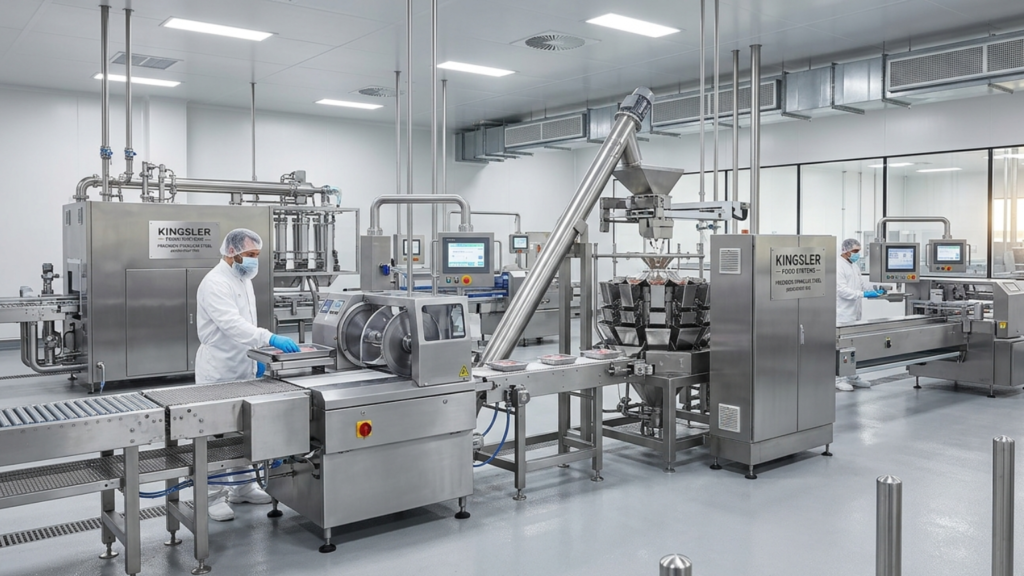
Importing food processing equipment into the United States means clearing a strict set of hygiene, safety, and design requirements before your machinery can legally run in any food production facility. Two agencies control these rules, the FDA and the USDA, and failing either one means delays, rejections, or equipment that never makes it to the production floor.
For importers and food producers, FDA USDA machinery compliance is not optional paperwork. Every piece of equipment that enters a US food facility must satisfy FDA USDA machinery compliance standards, no exceptions. It is the legal and operational foundation of every food equipment import. This guide covers what each agency requires, where the standards differ, what documentation you need, and how to avoid the most common FDA USDA machinery compliance mistakes, so you can import with confidence. Understanding FDA USDA machinery compliance before you order is the single most cost-effective step you can take.
What Is FDA and USDA Machinery Compliance?
FDA and USDA machinery compliance refers to the set of hygiene, safety, and design standards that food processing equipment must meet to be legally used in food production in the United States.
The FDA governs the broader food industry, including packaged goods, beverages, seafood, and produce. The USDA, through its Food Safety and Inspection Service (FSIS), covers meat, poultry, and egg products. Both agencies can inspect facilities, reject non-compliant equipment, and penalize operators who fall short of FDA USDA machinery compliance requirements.
According to the U.S. Food and Drug Administration, all facilities that manufacture, process, pack, or hold food for US consumption must register with the FDA, and their equipment must meet the same FDA USDA machinery compliance standards.
Why Compliance Is Important
FDA USDA machinery compliance protects your business at three levels:
- Ensures food safety: compliant machinery prevents biological, chemical, and physical contamination during production
- Prevents contamination: hygienic design eliminates bacteria traps, residue buildup, and cross-contamination risks
- Required for legal import and operation: non-compliant equipment may be detained or destroyed at the port of entry
FDA Requirements for Food Processing Machinery
FDA requires food processing machinery to follow sanitary design principles, use food-safe materials, and prevent contamination during food production.
The primary standard is 21 CFR Part 117 (Current Good Manufacturing Practice), which sets baseline requirements for equipment design, maintenance, and sanitation. FDA requirements for food processing equipment apply to any machinery with direct or indirect food contact, conveyors, mixers, fillers, cutters, and packaging lines.
Key FDA Standards
FDA requirements for food processing equipment focus on four areas:
- Food-grade stainless steel materials: food contact surfaces must use non-toxic, corrosion-resistant materials, typically AISI 304 or 316 stainless steel
- Easy-to-clean surfaces: smooth, accessible surfaces with no crevices where food residue or moisture accumulates
- No contamination points: no hollow rollers, exposed threads, or unsealed cavities that could harbor bacteria
- Safe lubrication systems: food-grade lubricants only on components near food contact zones
Equipment Design Requirements
FDA requirements for food processing equipment also cover build quality: smooth welds with no pits or rough edges, no rust-prone materials in food contact zones, full drainage capability, and sealed bearings to prevent contamination from mechanical parts.
Kingsler Machinery’s food equipment sourcing services are built around these FDA benchmarks, ensuring equipment from Chinese manufacturers meets US standards before it ships.
USDA Requirements for Food Processing Equipment
USDA regulations focus on meat, poultry, and dairy processing equipment to ensure hygienic handling, sanitation, and contamination prevention.
USDA compliance food machinery standards are enforced through continuous FSIS inspector presence in regulated facilities, a more hands-on model than FDA audits. USDA compliance food machinery standards are stringent because raw animal proteins carry a significantly higher contamination risk.
Key USDA Standards
USDA compliance food machinery standards require:
- Strict sanitation protocols: equipment must meet microbiological cleanliness standards, not just visual inspection
- Easy disassembly for cleaning: all food contact surfaces must be fully accessible and sanitizable without special tools
- Compliance with inspection guidelines: machinery must allow FSIS inspectors to examine equipment during live operation
Industries Covered
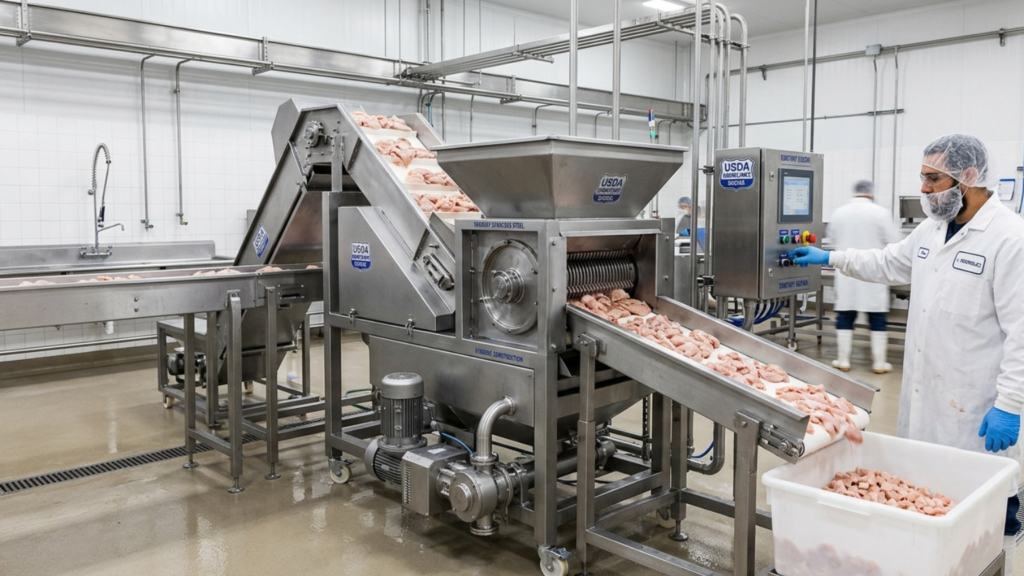
USDA compliance food machinery standards apply to meat processing (grinders, slicers, mixers), dairy production (pasteurizers, filling lines), and poultry processing (evisceration, chilling, and portioning equipment).
FDA vs USDA Machinery Compliance Differences
| Factor | FDA | USDA |
| Coverage | General food industry | Meat, poultry, dairy |
| Focus | Food safety and sanitary design | Sanitation inspection |
| Inspection Level | Moderate, periodic audits | Strict, continuous FSIS presence |
| Equipment Rules | Hygiene and material standards | Hygiene, facility compliance, HACCP |
| Regulatory Authority | 21 CFR Part 117 | 9 CFR Parts 416 and 417 |
Both frameworks share the same goal. That said, food processing machinery regulations USA under the USDA are more prescriptive and inspection-intensive, particularly for raw animal protein processing.
Key Machinery Design Requirements for Compliance
Regardless of FDA or USDA jurisdiction, food processing machinery regulations USA share universal design principles, and FDA USDA machinery compliance depends on getting all of them right.
Stainless Steel Usage
Sanitary design food machinery standards require food-grade stainless steel (AISI 304 or 316) on all food contact surfaces. Corrosion resistance is mandatory; any surface that degrades introduces contamination risk and will fail inspection. Non-contact structural components may use other materials but must not shed particles into the food zone.
Hygienic Design Principles
Achieving FDA USDA machinery compliance also requires meeting sanitary design food machinery standards at the surface level: a minimum Ra 0.8 µm surface finish on food contact zones, fully radiused internal angles (minimum 3mm), complete liquid drainability, and CIP (Clean-In-Place) or full disassembly cleaning capability.
Safety Mechanisms
Hygienic equipment design FDA USDA standards also cover operator safety, FDA USDA machinery compliance covers the operator as well as the food: emergency stop systems at multiple positions, physical guards on all moving parts with interlocks, and IP65-rated electrical enclosures for washdown environments.
Common Compliance Mistakes Importers Make
Most FDA USDA machinery compliance failures are avoidable, yet they cost importers significant time and money every year. The compliance and sourcing team helps importers verify manufacturer credentials and documentation before production begins. The most common mistakes importers make include:
- Using non-food-grade materials: carbon steel or standard aluminum food contact surfaces fail cGMP and FSIS inspection, often requiring costly rework or replacement
- Ignoring sanitation design rules: machinery that looks clean but has hidden cavities, open seams, or improper welds creates bacteria traps that fail regulatory review
- Missing documentation requirements: Arriving at customs without material certificates or compliance declarations causes detention and delays
- Buying non-certified machinery: sourcing from manufacturers who claim compliance without documentation puts the entire import at legal risk
Need expert help navigating FDA and USDA compliance for your next equipment import? Contact Kingsler Machinery for professional compliance support, pre-shipment inspection, and sourcing from verified Chinese manufacturers.
FDA and USDA Certification Process for Machinery
Achieving FDA USDA machinery compliance is demonstrated through documentation, third-party testing, and inspection, not a single universal certificate.
Documentation Requirements
For hygienic equipment design FDA USDA compliance, importers need:
- Material certificates: mill certificates confirming stainless steel grade and composition
- Design compliance proof: declarations confirming the machine meets 3-A Sanitary Standards, NSF/ANSI, or equivalent
- Safety testing reports: third-party lab documentation for electrical safety (UL or CE) and washdown ratings
Inspection Process
Food processing machinery regulations USA compliance follows three stages: factory inspection before shipment to verify build quality and materials; equipment testing to confirm sanitation performance; and final customs clearance with complete documentation followed by FDA or FSIS review at operation.
Why Compliance Matters for Importers
FDA USDA machinery compliance ensures machinery can legally enter the US market and operate safely in food production environments without regulatory penalties.
Key Benefits
- Smooth customs clearance: complete documentation means your machinery clears without detention or additional requests
- Market approval: compliant equipment opens regulated facilities and commercial food manufacturers who won’t accept non-certified machinery
- Reduced legal risk: non-compliant equipment exposes operators to FDA Warning Letters, FSIS enforcement, and facility shutdown
According to USDA Food Safety and Inspection Service guidelines, facilities with non-compliant equipment are subject to regulatory action that can halt production entirely.
How to Ensure Your Machinery Meets FDA and USDA Standards
Work with Certified Manufacturers: Source from suppliers with a track record in the US market who can demonstrate hygienic equipment design FDA USDA experience, and provide compliance documentation at the quoting stage.
Request Compliance Documentation: Get material certificates, sanitary design declarations, and NSF or 3-A certifications before production starts. Manufacturers who can’t provide these early won’t produce compliant equipment.
Conduct Pre-Shipment Inspection: A factory inspection before shipping is your last opportunity to verify surface finishes, weld quality, and design compliance before the machine is in transit.
Verify Material Quality: Cross-reference mill certificates against declared grades. Sanitary design food machinery standards also require you to verify that surface finishes and weld quality match what was specified. Material substitution is a common risk and a leading cause of FDA requirements for food processing equipment failures at the US border, and a direct path to FDA USDA machinery compliance rejection. Hygienic equipment design FDA USDA expectations extend to material traceability, not just design.
Final Thought
FDA USDA machinery compliance is the quality benchmark that protects your investment, your customers, and your market access. Every compliant machine is built around three non-negotiables: hygiene design that meets sanitary design food machinery standards, food-grade stainless steel throughout all food contact zones, and documentation accurate enough to satisfy US customs and regulatory reviewers. Get these right, and your equipment clears smoothly; get them wrong, and the cost of correction far exceeds the cost of doing it properly from the start.
Proper FDA USDA machinery compliance ensures safe, legal, and smooth import operations from the factory to the production floor. Treating it as a procurement checklist, not an afterthought, separates importers who scale efficiently from those stuck reworking shipments. Importers who prioritize FDA USDA machinery compliance avoid costly surprises and earn the trust of US food facilities that cannot work with non-compliant equipment.
Planning to import food processing equipment? Kingsler Machinery is your goto for FDA USDA machinery compliance support and sourcing from China.
FAQs
What is FDA compliance for machinery?
FDA compliance means food processing equipment meets the sanitary design, material safety, and contamination prevention standards in 21 CFR Part 117. Compliant machinery uses food-grade materials, has cleanable surfaces, and prevents contamination during production.
What is USDA approval for food equipment?
USDA approval confirms that equipment used in meat, poultry, or egg processing meets FSIS sanitation and hygienic design standards. USDA-regulated facilities typically have continuous inspector presence, making USDA compliance food machinery standards among the most rigorous in the food industry.
Do all food machines need FDA certification?
There is no single FDA certificate, but all equipment in FDA-regulated food facilities must comply with cGMP standards. FDA requirements for food processing equipment apply to any machine that contacts food or operates in a food facility.
What materials are required for food machinery?
Sanitary design food machinery standards require food-grade stainless steel (AISI 304 or 316) on all food contact surfaces. Carbon steel, standard aluminum, and galvanized materials are not acceptable in food contact applications.
Can non-certified machines be imported into the USA?
Request material certificates, sanitary design documentation, and third-party certifications from the manufacturer. Arrange a pre-shipment inspection to verify compliance with food processing machinery regulations USA, and consult a specialist familiar with hygienic equipment design FDA USDA requirements.